

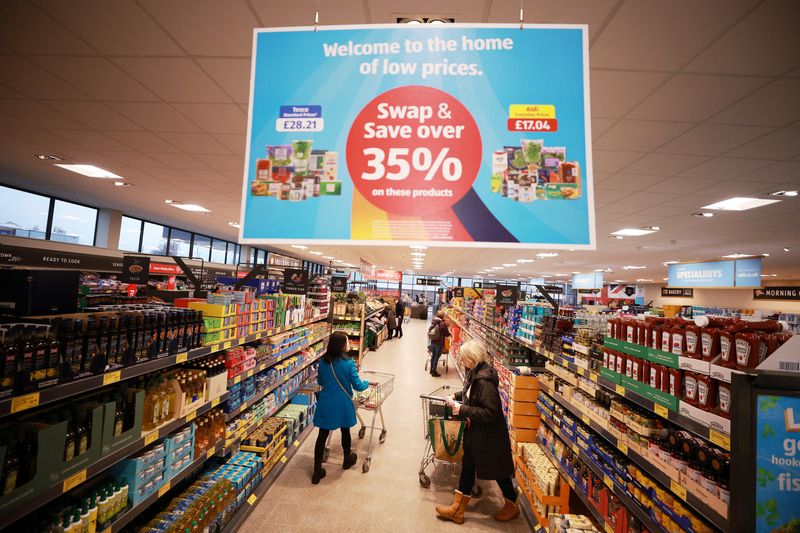
© Reuters. Buyers push trolleys alongside an aisle inside an ALDI grocery store close to Altrincham, Britain, February 20, 2023. REUTERS/Phil Noble
2/3
By James Davey
LONDON (Reuters) – Britain’s large supermarkets say they’ve by no means been extra aggressive on worth, but their prospects are nonetheless flocking to German-owned low cost shops Aldi and Lidl.
And the discounters’ grocery store sweep nonetheless has a protracted strategy to run, business executives say, with Aldi UK CEO Giles Hurley pledging Britain’s lowest costs “it doesn’t matter what”.
That’s forcing Britain’s main gamers – market chief Tesco (OTC:), Sainsbury’s, Asda and Morrisons – to chop extra prices to allow them to preserve a lid on costs and cling on to consumers who’ve been hit by a price of residing disaster.
“Over the Christmas interval alone consumers switched 58 million kilos ($70 million)(of purchases) to Lidl from Tesco and Sainsbury’s,” Lidl GB CEO Ryan McDonnell advised Reuters.
“That is not simply from prospects visiting new shops.”
The discounters proved the large winners over the festive interval, luring consumers from all the normal teams, with Aldi and Lidl’s December gross sales rising 26% and 25% respectively.
The German duo have already grabbed greater than 16% of the British market between them however analysts, lecturers and grocery executives anticipate that to double inside a decade as they spend tons of of tens of millions of kilos to develop.
Aldi is concentrating on 1,200 UK shops by 2025 from its present 990, and Lidl is aiming for 1,100, from greater than 950.
Britain’s incumbents are struggling to compete partially because of the scale of the 2 relative newcomers, which between them are current in additional than 30 international locations together with the USA, the place Aldi particularly is prospering.
The discounters’ dimension ensures higher phrases when negotiating provider offers, whereas they’re additionally in a position to take a longer-term view on revenue as a result of they’re privately-owned and shouldn’t have to fret about shareholder returns or inventory costs.
Discounters maintain greater than a 3rd of the grocery store sector in international locations resembling Germany, Poland, Denmark and Norway and the British buying panorama is more likely to observe go well with.
“The UK will mannequin to what lots of the European international locations have,” Leigh Sparks, professor of retail research on the College of Stirling in Scotland, advised Reuters.
Aldi UK, owned by Aldi Sud, is now Britain’s fourth largest grocer with a market share of 9.2%, in response to researcher Kantar, whereas Lidl, a part of the Schwarz Group, is sixth greatest with 7.1%.
PRICE PRESSURES
Tesco and Sainsbury’s have already responded by stripping out in-store meat, fish and deli counters and changing giant numbers of check-out workers with numerous types of automation.
This displays classes realized through the 2008 monetary disaster when Aldi and Lidl secured a foothold in Britain by doing a significantly better job of holding costs down on their vary of two,000 largely own-brand merchandise, versus 30,000-40,000 on the large supermarkets.
With Britain teetering on the point of recession, and meals worth inflation above 15%, the normal gamers are this time placing up a struggle. Whereas the value hole with the discounters stays materials – at 14-18% for a forty five merchandise buying basket in response to Which? – it has narrowed lately.
Tesco and Sainsbury’s are actually matching Aldi costs on tons of of key gadgets and utilizing buyer loyalty schemes, whereas they’ve accepted a revenue hit to maintain costs down.
“We’re within the strongest worth place now we have been in for a lot of, a few years,” Tesco CEO Ken Murphy mentioned final month, whereas Sainsbury’s CEO Simon Roberts mentioned it was elevating costs by lower than all its key rivals.
Some buyers say the worst of the ache is behind the normal gamers and that dividend yields of almost 5% at Tesco and Sainsbury’s make them stable investments.
“They’re paying engaging dividends, they are much less complicated companies than they had been and so they’re very money generative, that’s the attraction,” mentioned a prime 50 shareholder in each.
(Graphic: Aldi, Lidl acquire bigger market share, https://ift.tt/nEvkHpi
RE-BASING?
Sector executives, talking on situation of anonymity, mentioned the additional rise of Aldi and Lidl is inexorable.
“The one query is who cedes the share and at what level does that turn into problematic for one or a number of the gamers,” one sector veteran advised Reuters.
“Sooner or later, there’ll find yourself being some type of business re-basing or consolidation as a result of the quantity of house being put down is larger than the rise in demand.”
Costcutter proprietor Bestway has constructed a 4.5% stake in Sainsbury’s however says it isn’t planning a takeover. Qatar’s sovereign wealth fund owns 14.3%.
Whereas in 2019, Britain’s competitors authorities blocked Sainsbury’s proposed takeover of Asda, the panorama is now totally different, with Aldi forward of Morrisons by Kantar’s measure.
“No person’s going to take Tesco out however sooner or later someone would possibly take Sainsbury’s out,” the sector veteran mentioned.
($1 = 0.8273 kilos)
from NYSE Updates – My Blog https://ift.tt/lxmK2UR
via IFTTT


No comments:
Post a Comment